

Testing
The testing process comprised dynamic and static evaluations. Dynamic testing involves examining factors such as speed, acceleration, and component damage during vehicle operation. In static testing, the student measured the vehicle's total weight, assessed deflection in the chassis/axles/gear shaft, evaluated overall dimensions, and verified component requirements such as the motor and battery. These tests ensured that the vehicles met all requirements for the ASME Baja competition, which includes the slalom, sprint, and Baja off-road course. Testing primarily took place at Hogue Hall using tools and the environment available there. Necessary tools included a ruler or tape measure, a cell phone with a speedometer app, and a scale. Speed tests utilized the same cell phone, and all testing occurred outdoors on textured flat concrete.
During the first initial testing phase, the student aimed to assess an RC car's ability to reach the required speed within 10 seconds. They chose an acceleration test over a standard speed test after reevaluating their approach. An issue that arose during the test was that the steering was not straight which made the vehicle difficult to operate. To resolve this, the team redesigned the steering rack for improved stability which in turn helped improve the operation of the vehicle.
Test 1
An acceleration test was conducted on a car for test 1. A cell phone was attached to the car to measure its top speed. The test required the car to reach 25 MPH within a span of 10 seconds. However, the car only reached 23 MPH in 10 seconds. Upon applying the first kinematic equation to calculate acceleration, the student determined that the RC vehicle did not meet the specified requirement.

Figure 1 Start Postion for Acceleration Test

Figure 2 Acceleration test Location
Figure 3 Acceleration test
Test 2
A deflection test on the bare chassis was conducted for test 2. Using the Instron located in Central Washington Houge building room 127, the student was able to determine the deflection value. The requirement for this test was that it would deflect less than .30 inches which it met. The maximum deflection chassis from the test was .047 inches.
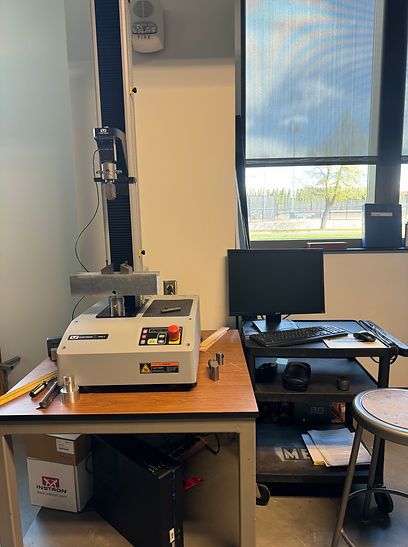
Figure 4 Instron in CWU Houge

Figure 5 RC vehicle weight on scale

Figure 4 Deflection test set up
Figure 4 Deflection test